Overgrown hedges can quickly turn a meticulously kept garden into an unruly landscape, demanding significant time and effort to restore. For any gardener, whether a seasoned professional or a dedicated homeowner, efficiency and precision are paramount when tackling these tasks. This is where the double-sided hedge trimmer excels, offering a superior solution for faster, more versatile, and more balanced trimming. This comprehensive guide will delve into everything you need to know about these essential tools, from understanding their core benefits and exploring different types to a detailed buying guide, top recommendations, and crucial maintenance tips, ensuring your hedges remain pristine with less effort.
An Overview of Hedge Trimmers
A hedge trimmer is a powered gardening tool specifically designed for maintaining and shaping hedges, shrubs, and bushes. Its primary function is to cut and prune foliage, promoting healthy growth and achieving desired aesthetic forms. From compact, intricate shaping to managing vast expanses of greenery, these machines are indispensable for garden upkeep.
The evolution of hedge trimmers has transformed hedge maintenance from a laborious manual chore to an efficient, streamlined process. Early models were entirely manual, requiring considerable physical exertion. The advent of electric power brought corded versions, offering consistent power but limiting mobility. Today, battery-powered cordless hedge trimmers dominate the market, combining impressive power with unparalleled freedom of movement, while gas-powered models continue to serve those with the most demanding, large-scale tasks. Among these, the double-sided blade design has emerged as a cornerstone of efficiency, offering dual cutting action that significantly speeds up trimming.
Detailed Classification of Hedge Trimmers
Understanding the various types of hedge trimmers available is crucial for selecting the model that best suits your specific gardening requirements. They are primarily categorized by their power source and blade design.
By Power Source
The engine or power source of a hedge trimmer dictates its power, mobility, and environmental impact, making it a critical choice for any user.
- Electric (Corded): These trimmers plug directly into a power outlet, offering unlimited runtime and consistent power output without the need for fuel or battery charging. They are typically lightweight and less expensive, making them an excellent choice for smaller gardens or areas close to a power source. However, their major drawback is the restrictive cord, which limits range and poses a tripping or cutting hazard.
- Cordless (Battery-Powered): Gaining immense popularity, battery-powered hedge trimmers provide exceptional freedom of movement without the hassle of cords or the fumes of gas. They operate quietly, produce zero emissions, and often feature low vibration, enhancing user comfort. While their power output has significantly improved with advancements in battery technology, their runtime is limited by battery life, and they may be less powerful than top-tier gas models. Investing in spare batteries can mitigate runtime concerns for larger jobs.
- Gas-Powered: For sheer power and extended runtime, gas hedge trimmers remain the preferred choice for professional landscapers and those with very large properties or tough, overgrown hedges. They can cut through thicker branches with ease and offer complete mobility. The trade-offs include higher noise levels, heavier weight, exhaust emissions, and the need for regular maintenance, including fuel mixing and engine care.
By Blade Design
The blade configuration is fundamental to a hedge trimmer’s performance, particularly influencing cutting efficiency and versatility.
- Double-Sided Blades: The focal point for rapid trimming, double-sided hedge trimmers feature cutting teeth on both sides of the blade. This design allows users to cut in both forward and backward strokes without needing to reposition the tool, drastically increasing cutting efficiency. They are ideal for shaping, sculpting, and general maintenance of various hedge sizes, offering a balanced feel and improved maneuverability in tight spaces. While slightly less precise for achieving perfectly straight, very long lines compared to their single-sided counterparts, their speed and versatility make them the go-to for most residential users.
- Single-Sided Blades: In contrast, single-sided trimmers have cutting teeth on only one edge. They are often lighter and considered safer due to a guard on the non-cutting side. These are traditionally favored by professionals for creating long, perfectly straight lines on uniform hedges, offering precise control over the cutting path.
Comparing Hedge Trimmer Types
Choosing the right hedge trimmer involves weighing the advantages and disadvantages of each power source against your specific trimming needs.
| Feature | Corded Electric Hedge Trimmer | Cordless (Battery) Hedge Trimmer | Gas-Powered Hedge Trimmer |
|---|---|---|---|
| Power | Moderate, consistent | Moderate to high, depends on battery voltage | Highest |
| Weight | Lightest | Light to moderate | Heaviest |
| Noise | Low | Very Low | Highest |
| Price | Lowest initial cost | Moderate to high (includes battery/charger) | Highest initial cost, ongoing fuel expense |
| Flexibility | Limited by cord length | High (unrestricted mobility) | Highest (unrestricted mobility) |
| Maintenance | Low (blade care, cleaning) | Low (blade care, cleaning, battery charging) | High (engine, fuel, spark plugs, blade care) |
| Emissions | Zero (at point of use) | Zero | High |
| Runtime | Unlimited (with power source) | Limited by battery life | Long (with fuel) |
| Best For | Small gardens, areas near power, light trimming | Most homeowners, medium-sized gardens | Large properties, thick hedges, professional use |
Choosing the Right Double-Sided Hedge Trimmer
Selecting the ideal double-sided hedge trimmer involves a careful assessment of your gardening needs, budget, and the specific features that will enhance your trimming experience.
Assess Your Trimming Needs
The first step is to understand the scope and nature of your hedge maintenance tasks.
- Hedge Size/Area: For small to medium-sized hedges, a lighter, more maneuverable trimmer with a shorter blade (around 18-22 inches) is often sufficient. Larger properties with extensive hedging will benefit from longer blades (24-26 inches or more) to cover more surface area efficiently, reducing overall trimming time.
- Hedge Type/Thickness: The type of plants in your hedge directly impacts the required cutting capacity. Thin-leaved shrubs and new growth typically require less power and a smaller tooth spacing (15-20mm). Mature hedges with woody stems and thicker branches demand a larger tooth gap (25-35mm) and a more powerful motor to prevent jamming and ensure clean cuts.
- Frequency of Use: If you trim hedges occasionally, a reliable mid-range cordless electric model might suffice. For frequent or extensive use, investing in a more robust model with longer battery life or a gas-powered option will be more beneficial and durable over time.
Budget Considerations
Hedge trimmers vary significantly in price, influenced by power source, brand reputation, and features. Corded electric models are generally the most affordable, followed by battery-powered options which incur the cost of batteries and chargers. Gas-powered trimmers typically represent the highest initial investment, plus ongoing fuel and maintenance costs. Evaluate the value and performance against your budget, considering that a slightly higher investment upfront can lead to greater durability, efficiency, and comfort in the long run.
Key Features to Prioritize
Specific features can greatly enhance a double-sided hedge trimmer’s performance, safety, and ease of use.
- Blade Length: While longer blades cover more area, making straight passes faster, they can be more cumbersome in tight spaces. Shorter blades offer greater precision and maneuverability for intricate shaping. Most residential users find a blade length between 22 and 26 inches to be a versatile sweet spot.
- Tooth Spacing (Blade Gap): This measurement, the distance between the blade teeth, dictates the maximum diameter of branches the trimmer can cut. For general maintenance, 18-20mm is common, but for woody or overgrown hedges, look for 25mm or more.
- Motor Power/Strokes Per Minute (SPM): Higher SPM generally translates to faster, cleaner cuts and less strain on the motor when dealing with denser foliage. For fast trimming, aim for models with 2,800 SPM or higher.
- Weight & Balance: A well-balanced and lightweight trimmer significantly reduces user fatigue, especially during extended trimming sessions. This is particularly important for double-sided models, which can sometimes be heavier than single-sided ones. Try to hold the trimmer and check its balance.
- Safety Features: Essential for preventing accidents, look for features like dual-action blades that reduce vibration, a dual-hand operation requirement (where both hands must be on the handles to operate), blade guards, and an automatic shut-off that stops the blades when the trigger is released.
- Ergonomics & Convenience: Features such as a rotating rear handle allow you to adjust the cutting angle comfortably, reducing strain on wrists and arms, especially when trimming vertical surfaces or hedge tops. Anti-vibration systems and reduced noise output also contribute to a more pleasant and comfortable trimming experience.
Top 5 Best Double-Sided Hedge Trimmers for Fast Trimming
Based on extensive testing and user feedback, these double-sided hedge trimmers stand out for their efficiency, power, and overall performance, making quick work of your hedging tasks. All selected models are cordless, offering the modern gardener maximum mobility and convenience.
1. Stihl HSA 60 Hedge Trimmer
The Stihl HSA 60 consistently receives high marks for its exceptionally smooth and precise cutting action. Its double-sided, diamond-ground blades effortlessly slice through foliage, even tackling thicker branches without snagging. Users frequently praise its surprisingly quiet operation and minimal vibration, making extended use more comfortable. Compatible with Stihl’s AK battery system, it offers reliable performance and good battery life.
2. RYOBI 40V HP Hedge Trimmer
The RYOBI 40V HP is a strong contender for its balance of comfort, power, and practical features. It boasts a comfortable grip and an intuitively designed rotating rear handle, allowing for easy adjustment of cutting angles without wrist strain. With 26-inch dual-action blades and a generous 1-inch cutting capacity, it handles regular maintenance and seasonal pruning efficiently at 3,000 strokes per minute, delivering clean, fast cuts with minimal vibration.
3. Milwaukee M18 FUEL 24-Inch Hedge Trimmer
Designed for more aggressive cutting tasks, the Milwaukee M18 FUEL trimmer is a prosumer favorite. It offers a fast cutting speed of 3,200 strokes per minute and an impressive capacity to cut branches up to 1-1/4 inches thick, making it ideal for woodier growth that might challenge lesser tools. Its rotating handle, adjustable to five positions, enhances versatility and control for various trimming angles.
4. Husqvarna Hedge Master 320iHD60
Consistently rated as an “overall best” choice, the Husqvarna Hedge Master 320iHD60 combines robust performance with user-friendly design. While specific double-sided blade details were not exhaustively highlighted in every source, its strong reputation for cutting power and reliability makes it a top pick for efficient hedge maintenance. It’s part of a system known for quiet operation and low vibrations, making it suitable for prolonged use.
5. Ego Power+ 26-inch Hedge Trimmer HT2601
The Ego Power+ HT2601 is acclaimed for its excellent cutting speed and impressive blade gap. Its 51cm double-sided blade can handle growth up to 26mm, making it efficient for tidying up even areas with thicker branches. When integrated into a pole trimmer system, it offers six adjustable angles for its double-sided head, allowing users to tackle high hedges or cut at various angles with remarkable ease. This model is a powerhouse for quick and effective trimming across diverse hedge types.
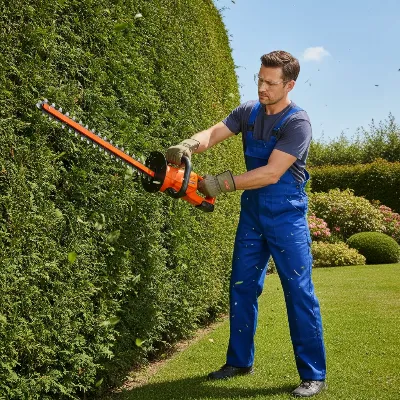 A person trimming a tall, dense hedge with a cordless double-sided hedge trimmer, showing dynamic movement and precise cuts.
Using and Maintaining Your Double-Sided Hedge Trimmer
Proper usage and consistent maintenance are key to maximizing the lifespan and performance of your double-sided hedge trimmer, ensuring safety and optimal results for years to come.
Safety First
Operating any power tool requires strict adherence to safety protocols to prevent accidents and injuries.
- Equip Proper Personal Protective Equipment (PPE): Always wear safety glasses or goggles to protect your eyes from flying debris. Heavy-duty gloves safeguard your hands from cuts and vibrations. Consider ear protection, especially with gas models, and long sleeves/pants to protect your skin.
- Inspect Before Use: Before each trimming session, perform a quick check of your trimmer. Look for any loose screws, damage to the blades or housing, and ensure the trigger and safety lock mechanisms are functioning correctly. Make sure blades are tight and free from excessive dirt or residue.
- Maintain Correct Posture: Hold the trimmer firmly with both hands, maintaining a balanced stance. Avoid overreaching, which can lead to loss of balance or control. Use the rotating handle features to adjust angles ergonomically, reducing strain.
- Be Aware of Surroundings: Always check the area for obstacles, hidden wires, or children and pets. For corded models, be extra vigilant about the power cable, keeping it away from the blades and your cutting path.
Regular Maintenance for Longevity
Consistent care not only keeps your hedge trimmer performing at its best but also prevents costly repairs and extends its operational life.
-
After Every Use: Immediately after trimming, clean the blades thoroughly. Sap, leaves, and debris can accumulate and harden, hindering performance and causing rust. Use a dry cloth to wipe off moisture, and a stiff brush to remove compacted debris. For stubborn sap, use a resin solvent or isopropyl alcohol. Store the trimmer indoors in a dry, secure place to prevent corrosion.
-
Weekly or Monthly Checks (Depending on Use):
- Lubricate Blades: Apply a suitable care oil or maintenance spray to both sides of the blades. Run the trimmer briefly to distribute the oil evenly, reducing friction and preventing wear and rust. This should be done whenever you feel the cutting performance start to drop.
- Inspect Power Source: For corded models, check the power cable for any signs of fraying or damage. For cordless models, inspect the battery condition and terminals, ensuring they are clean. Store batteries in a cool, dry place and avoid overcharging to maximize their lifespan.
- Check for Rust and Loose Fasteners: Periodically inspect the entire machine for any signs of rust or corrosion, especially around moving parts and joints. Tighten any loose screws or bolts that may have vibrated loose during operation.
- Air Filters (Gas Models): Regularly clean the air filter to ensure optimal engine performance.
-
Sharpening: Dull blades tear and shred leaves instead of cleanly slicing them, putting strain on the motor and damaging your hedges. Sharpen your blades whenever you notice this drop in cutting performance. For most residential users, sharpening once or twice a year is sufficient, but frequent professional use might require more frequent touch-ups. When sharpening, ensure the trimmer is powered off and the battery is removed (for cordless). Use a sharpening stone or file, always filing towards the cutting edge and maintaining the original blade angle.
“Regular maintenance isn’t just about preserving your tool; it’s about preserving the health and beauty of your hedges, ensuring clean cuts that promote vigorous growth.” – Admin, ReviewsRain.com
Conclusion
Choosing the right double-sided hedge trimmer for fast trimming can significantly transform your garden maintenance routine, making it more efficient and enjoyable. These versatile tools are designed to tackle a wide array of hedging tasks with speed and precision, from intricate shaping to broad sweeps across expansive greenery. By carefully considering your specific needs, prioritizing key features like blade length, tooth spacing, and ergonomics, and committing to regular safety practices and maintenance, you can ensure your investment yields beautiful, well-kept hedges for many seasons. Remember, a high-quality double-sided hedge trimmer is not just a tool; it’s an enhancement to your gardening experience.
What’s the biggest challenge you face when trying to achieve perfectly trimmed hedges?
Frequently Asked Questions
Are double-sided hedge trimmers always better than single-sided?
Double-sided hedge trimmers offer superior efficiency and versatility, allowing cuts in both directions and making them excellent for shaping and general maintenance, especially in varied or confined spaces. Single-sided trimmers, however, can provide greater precision for very long, straight lines and may be preferred by some professionals for specific tasks. For most homeowners aiming for fast trimming and versatility, double-sided models are the better choice.
How often should I sharpen my double-sided hedge trimmer blades?
You should sharpen your hedge trimmer blades whenever you notice them tearing or shredding leaves instead of making clean cuts. For typical residential use, this usually means once or twice a year. However, if you use your trimmer frequently or for professional work, you might need to sharpen them every 20 to 30 hours of use to maintain optimal cutting performance.
Can double-sided hedge trimmers cut thick branches?
The ability of a double-sided hedge trimmer to cut thick branches depends primarily on its tooth spacing (blade gap) and motor power. Models with wider tooth spacing (e.g., 25-35mm) and powerful motors are designed to tackle thicker, woodier stems more effectively. Always check the manufacturer’s specifications for the maximum cutting capacity to ensure it meets your needs.

The maintenance tips were super helpful! I always forget to clean and oil my blades after each use, but since reading about it, I’ve been much more diligent. My new Stihl double-sided trimmer is performing flawlessly, and I can tell the regular care is keeping it sharp and efficient. My hedges have never looked better, and it’s so much easier to keep them pristine.
I picked up a budget-friendly electric double-sided trimmer, one of the less expensive options mentioned. It works fine for my smaller hedges, but I’ve noticed it struggles a bit with thicker branches, even within the recommended cutting capacity. It’s okay for light maintenance, but I might need to upgrade if my hedges get much denser. Still, it’s better than shears!
I finally broke down and bought one of the recommended double-sided hedge trimmers, specifically the Greenworks 22-inch model. It’s been a game-changer for my overgrown privet hedge. The balance is fantastic, and I can get through my entire yard in half the time it used to take with my old single-sided trimmer. Definitely worth the investment for anyone serious about their landscaping.
I appreciated the detailed buying guide, especially the part about blade length. I ended up getting a 24-inch model, and it handles my larger shrubs perfectly. The double-sided feature really does make a difference for speed and even cuts. My only minor gripe is that it’s a bit heavier than I expected, but the power makes up for it.