To properly fuel a 2-stroke hedge trimmer, you must mix fresh, unleaded gasoline (89+ octane, preferably ethanol-free) with high-quality 2-stroke oil specifically for air-cooled engines (JASO FD or ISO-L-EGD rated) at the manufacturer’s recommended ratio, typically 50:1. This precise mixture ensures proper lubrication and prevents engine damage, which is crucial for the longevity and efficient operation of the tool.
Understanding Your 2-Stroke Hedge Trimmer
Two-stroke engines are compact powerhouses commonly found in outdoor power equipment like hedge trimmers, chainsaws, and leaf blowers. Their simpler design, with fewer moving parts than 4-stroke engines, results in lighter weight and a higher power-to-weight ratio, making them ideal for handheld tools where maneuverability is essential for precision trimming.
The key difference lies in their lubrication system. Unlike 4-stroke engines with a dedicated oil sump, 2-stroke engines rely on oil mixed directly into the fuel. This fuel-oil mixture lubricates the crankshaft, connecting rod, and cylinder walls as it passes through the engine, then combusts with the gasoline. This design streamlines the engine but places critical lubrication responsibility on the operator. For hedge trimmer buying guides on this site.
The Critical Role of Fuel Mixture
The fuel mixture is the lifeblood of your 2-stroke hedge trimmer, providing both power and vital lubrication to all moving parts within the engine’s combustion chamber. An incorrect balance of gasoline and oil leads to either excessive wear or performance issues, a common pitfall that can result in costly repairs and significantly shorten the trimmer’s lifespan.
Too much oil causes smoky exhaust, carbon buildup on the spark plug and in the exhaust port, and reduced engine power. The trimmer might struggle to start, run roughly, or foul the spark plug prematurely. Conversely, too little oil is far more damaging, leading to insufficient lubrication, overheating, and seizing of critical engine components. This “lean seizure” can permanently damage the piston and cylinder, often requiring a complete engine replacement, which typically exceeds the cost of a new trimmer.
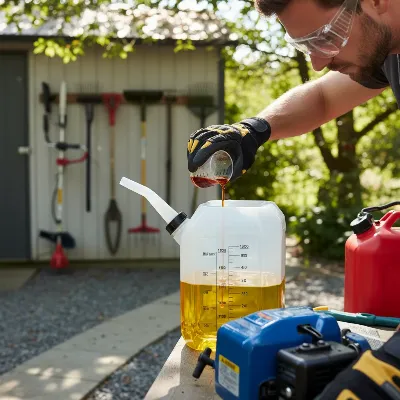 Person carefully mixing fuel and oil for a 2-stroke hedge trimmer, wearing gloves and eye protection in a well-ventilated outdoor area. Focus on precision measuring and a clean fuel container.
Essential Components for Your Fuel Mix
Creating the perfect fuel mixture requires selecting the right ingredients. Your hedge trimmer deserves high-quality gasoline and specialized 2-stroke oil to ensure optimal performance and protection.
Choosing the Right Gasoline
For most 2-stroke hedge trimmers, use fresh, unleaded gasoline with an octane rating of 89 or higher. While some manufacturers permit 87 octane, a slightly higher octane can improve performance and reduce pre-ignition risk, especially in hotter climates or during heavy use. The most crucial factor is using ethanol-free gasoline whenever possible. Ethanol, a common additive, can attract water and degrade rubber and plastic components in the fuel system over time. If ethanol-free fuel is unavailable, use fuel with no more than 10% ethanol (E10) and always add a fuel stabilizer to mitigate its effects. Avoid older or “stale” gasoline, as it can separate and cause starting and running problems.
Selecting the Correct 2-Stroke Oil
|
Our Picks for the Best Hedge Trimmer in 2026
As an Amazon Associate I earn from qualifying purchases.
|
||
| Num | Product | Action |
|---|---|---|
| 1 | BLACK+DECKER Electric Hedge Trimmer, 17-Inch Corded 3.2 Amp, Dual Action, Reduced Vibration, Cleaner Cut, Lightweight, 3800 Cuts per Min (BEHT150) |

|
| 2 | BLACK+DECKER 20V MAX Cordless Hedge Trimmer, Battery and Charger Included, 22 Inch Steel Blade Lightweight Bush Trimmer, Soft Grip, Less Vibration (LHT2220) |
|
| 3 | BLACK+DECKER Electric Hedge Trimmer, 16-Inch 3.0 Amp Compact Corded Power Hedge Trimmer (BEHT100) |
|
| 4 | Hedge Trimmer for Dewalt 20V Battery, Cordless Hedge Trimmer with 22'' Dual-Action Blade, 1600RPM, 3/5'' Cutting Width, Rotating Handle & Dual Switch Design (Battery Not Included) (Yellow) |
|
| 5 | Hedge Trimmer for Dw 20V Battery,Hedge Trimmer Cordless with 22'' Dual-Action Blade and 3/5'' Cutting Capacity,1600RPM& Safety Lock (Battery Not Included) |
|
| 6 | Electric Hedge Trimmer Cordless Compatible with DEWALT 20V MAX Battery, 20-Inch Cordless Hedge Trimmer, Brushless Bush Trimmer, 2/3'' Cutting Capacity, Lightweight & Rotatable Handle(No Battery) |
|
| 7 | SEESII 20V Hedge Trimmer Cordless: 20" Electric Bush Trimmer - Dual 4.0Ah Batteries, Dual-Action Blade, 0.71" Blade Gap, Rotatable Handle, Lightweight Handheld Grass Shrub Clipper for Garden Yard |
|
| 8 | Cordless Hedge Trimmer 22-Inch Compatible with DEWALT 20V MAX Battery, Electric Hedge Trimmer Cordless, Bush Trimmers for Garden, Battery Powered Hedge Trimmers (Tool Only) |
|
| 9 | WORX 22" Cordless Hedge Trimmer, Electric Hedge Trimmer with Dual-Action Blades, Lightweight Bush Trimmer with 4.4 LBS, Battery & Charger Not Included, WG261.9 |
|
| 10 | BLACK+DECKER 18-Inch Electric Hedge Trimmer (BEHT200) |
|
Many operators make critical mistakes here. Never use oil designed for 4-stroke engines (like car oil) or for water-cooled 2-stroke engines (often labeled TCW-3). These oils lack the specific properties required for air-cooled 2-stroke engines and can cause severe damage. Instead, always choose a high-quality 2-stroke oil specifically formulated for air-cooled engines. Look for ratings like JASO FD or ISO-L-EGD, which signify oils designed to burn cleanly and provide excellent lubrication under the high temperatures these engines generate.
There are generally three types of 2-stroke oil:
- Mineral Oils: These petroleum-based oils are typically the most economical. They provide adequate lubrication but can leave more carbon deposits over time, potentially increasing maintenance.
- Semi-Synthetic Oils: A blend of mineral and synthetic oils with additives, offering a cleaner burn and better lubrication than pure mineral oils at a mid-range price point.
- Full Synthetic Oils: The premium choice, offering superior lubrication, a much cleaner burn with minimal smoke, and fewer carbon deposits. They are ideal for high-performance engines and can extend engine life and reduce maintenance. While more expensive upfront, their benefits in engine health and performance often outweigh the cost.
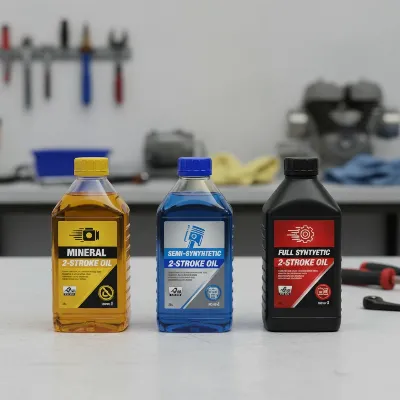 Various bottles of 2-stroke engine oil with different labels (mineral, semi-synthetic, synthetic) arranged neatly, emphasizing clarity of product choice. The background is a clean workbench.
Determining the Correct Fuel-to-Oil Ratio
The most important information before mixing fuel is your hedge trimmer’s specific fuel-to-oil ratio, explicitly stated in its owner’s manual. Ignoring this instruction is the fastest way to cause engine problems, as manufacturer guidelines are tailored to the engine’s design, tolerances, and lubrication requirements.
While checking the manual is non-negotiable, a common ratio for many modern 2-stroke hedge trimmers is 50:1. This means for every 50 parts of gasoline, you add 1 part of 2-stroke oil. Other common ratios include 40:1, 25:1, or even 20:1 for older models or specific brands. For example:
- For a 50:1 ratio:
- 1 gallon of gasoline requires approximately 2.56 fluid ounces of 2-stroke oil.
- 1 liter of gasoline requires approximately 20 milliliters of 2-stroke oil.
- For a 40:1 ratio:
- 1 gallon of gasoline requires approximately 3.2 fluid ounces of 2-stroke oil.
- 1 liter of gasoline requires approximately 25 milliliters of 2-stroke oil.
Always use a dedicated measuring container with clear markings to ensure precise ratios. Pre-measured “one-shot” oil bottles designed for specific fuel quantities (e.g., a 2.6 oz bottle for 1 gallon at 50:1) can also simplify the process.
Step-by-Step Guide to Mixing 2-Stroke Fuel
Mixing 2-stroke fuel is a straightforward process, but accuracy and safety are key. Follow these steps meticulously to ensure your hedge trimmer is properly fueled.
Gather Your Supplies
Before you begin, ensure you have all necessary items ready:
- Fresh, unleaded gasoline (ethanol-free preferred).
- High-quality 2-stroke oil for air-cooled engines (JASO FD/ISO-L-EGD).
- A clean, dedicated fuel mixing container with volume markings (plastic or metal, specifically designed for fuel). Never use a container that has held other liquids.
- A smaller, accurate measuring cup or syringe for the oil. Many 2-stroke oil bottles come with integrated measuring features.
- A funnel to prevent spills when transferring fuel.
- Personal Protective Equipment (PPE): Safety glasses and chemical-resistant gloves are essential.
The Mixing Process
With your supplies ready and in a well-ventilated outdoor area, you can begin mixing:
- Add Half the Gasoline: Pour approximately half of the total amount of gasoline you intend to mix into your clean fuel container. This initial amount provides a good base for the oil to dissolve effectively.
- Add All the 2-Stroke Oil: Carefully measure and pour the entire required amount of 2-stroke oil into the container.
- Mix Gently: Secure the lid on your fuel container and gently agitate it. Swirl the container for about 30 seconds to allow the oil to thoroughly mix with the initial gasoline. This pre-mixing helps ensure the oil is evenly dispersed.
- Add Remaining Gasoline: Open the container and add the rest of the gasoline until you reach your desired total volume.
- Final Mix: Re-secure the lid and gently shake the container again for another minute. This ensures a homogeneous mixture before pouring it into your hedge trimmer.
Always mix your fuel in a clean, airtight container specifically designed for fuel. This not only prolongs the shelf life of your mixture but also prevents permeation and evaporation.
Storage Guidelines
Proper storage is crucial for maintaining the integrity of your fuel mixture and the health of your engine.
- Do not mix more than a one-month supply of fuel at a time. Fuel can degrade over time, especially if it contains ethanol, leading to poor engine performance and potential damage.
- Store mixed fuel in an approved, airtight fuel can. Ensure the container is clearly labeled “2-Stroke Fuel Mix” and includes the date of mixing and the ratio used.
- Keep the fuel can in a cool, dark, well-ventilated area, away from direct sunlight, heat sources, and open flames. A shed or garage is suitable, but never store fuel inside your home.
- Consider a fuel stabilizer. If you anticipate storing mixed fuel for longer than a month, or if you must use ethanol-blended gasoline, add a high-quality fuel stabilizer to extend its shelf life up to 12 months.
- Empty your hedge trimmer’s fuel tank before long-term storage. If you won’t be using your trimmer for several weeks or months, drain the fuel tank and run the engine until it stops. This prevents fuel from degrading inside the carburetor and fuel lines, which can lead to starting issues and costly repairs.
Common Mistakes and Troubleshooting
Even with the best intentions, errors can occur when mixing 2-stroke fuel. Recognizing these common mistakes can help you prevent them and troubleshoot issues if they arise.
One frequent error is using the wrong type of oil or fuel. Accidentally pouring 4-stroke engine oil or pure, unmixed gasoline into a 2-stroke engine is a surefire way to cause immediate and severe damage. Always double-check your oil and fuel sources. Another mistake is incorrectly measuring the ratio. Eyeballing quantities or using imprecise containers can lead to mixtures that are too rich or too lean, both of which are detrimental to engine health. Invest in proper measuring tools.
Mixing fuel in a dirty container can introduce contaminants into your engine, clogging fuel filters and carburetors. Always use a clean, dedicated fuel can. Lastly, storing mixed fuel for too long is a common problem. As discussed, old fuel can degrade, causing starting difficulties and poor performance. If your trimmer runs poorly, producing excessive smoke or struggling to start, the first step is often to check your fuel mixture. Ensure it’s fresh, correctly proportioned, and made with the right components.
Safety First: Handling Fuel Mixtures
Working with gasoline and oil demands respect and adherence to safety protocols. Fuel is highly flammable and its vapors can be harmful.
- Always wear appropriate Personal Protective Equipment (PPE). Safety glasses will protect your eyes from splashes, and chemical-resistant gloves will prevent skin contact with fuel and oil, which can cause irritation.
- Mix and handle fuel in a well-ventilated outdoor area. Never mix fuel indoors or in enclosed spaces where fumes can accumulate.
- Keep fuel away from open flames, sparks, and heat sources. This includes cigarettes, pilot lights, and hot engines.
- Use an approved, clearly labeled fuel container. Never store fuel in unmarked bottles or containers not designed for fuel storage.
- Clean up spills immediately. Use absorbent materials like sand or cat litter, then dispose of them properly. Avoid letting fuel soak into the ground or enter storm drains.
- Never siphon fuel by mouth. Use a pump or siphon specifically designed for fuel transfer.
- Store fuel securely. Keep it out of reach of children and pets, and ensure the container is tightly sealed to prevent leaks and evaporation.
> “The greatest asset in outdoor power equipment is not just the tool itself, but the operator’s commitment to proper maintenance, starting with the right fuel mix. It’s an investment in longevity.” – John Smith, Master Engine Technician
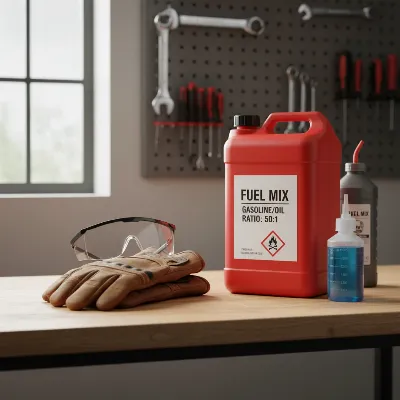 A neatly organized display of essential safety gear (gloves, safety glasses) laid out next to a properly labeled, red fuel container and a small oil measuring bottle on a workshop bench. Focus on organized safety and proper containers.
Conclusion
Mixing gas and oil for your 2-stroke hedge trimmer doesn’t have to be a daunting task. By consistently following the manufacturer’s recommended ratio, choosing high-quality, ethanol-free gasoline, and using a premium 2-stroke oil designed for air-cooled engines, you can ensure your equipment runs at its peak performance. Always use a clean, dedicated mixing container, adhere to the correct mixing procedure, and prioritize safety with proper PPE and ventilated work areas. A little attention to detail in your fuel preparation goes a long way in protecting your investment and making your hedge trimming tasks efficient and enjoyable.
Frequently Asked Questions
What happens if I put too much oil in my 2-stroke hedge trimmer fuel?
If you add too much oil to your 2-stroke hedge trimmer fuel, the engine may produce excessive smoke, run poorly, struggle to start, and develop carbon buildup on the spark plug and exhaust port. This can lead to reduced power and premature spark plug fouling, impacting overall performance.
Can I use regular car oil in my 2-stroke hedge trimmer engine?
No, you should never use regular car oil (4-stroke engine oil) in a 2-stroke hedge trimmer. Car oil is not formulated for 2-stroke engines and will lead to improper lubrication, significant carbon buildup, and severe internal damage, likely resulting in costly engine repairs or replacement.
How long can I safely store mixed 2-stroke fuel for my trimmer?
It is generally recommended not to store mixed 2-stroke fuel for more than one month. Over time, gasoline components can degrade and separate, especially if it contains ethanol. For longer storage, adding a high-quality fuel stabilizer can extend the shelf life up to 12 months.
What type of gasoline is best for a 2-stroke hedge trimmer?
The best gasoline for a 2-stroke hedge trimmer is fresh, unleaded gasoline with an octane rating of 89 or higher. Ethanol-free gasoline is strongly recommended because ethanol can damage engine components. If ethanol-free fuel is unavailable, use E10 (up to 10% ethanol) combined with a fuel stabilizer.
Why does my hedge trimmer produce a lot of smoke after refueling?
Excessive smoke, particularly bluish smoke, from your hedge trimmer after refueling typically indicates that your fuel mixture contains too much oil or that the oil quality is poor. It can also be a sign of old, stale fuel or a dirty air filter. Always check your mixing ratio and ensure you are using fresh, correctly proportioned fuel.
Mixing 2-Stroke Fuel for a Hedge Trimmer
This guide outlines the steps to correctly mix gasoline and 2-stroke oil for your hedge trimmer, ensuring optimal engine performance and longevity.
Collect fresh, unleaded gasoline (89+ octane, ethanol-free preferred), high-quality 2-stroke oil (JASO FD/ISO-L-EGD), a clean fuel mixing container, an accurate measuring cup for oil, a funnel, and essential PPE like safety glasses and chemical-resistant gloves.
Pour approximately half of the total desired gasoline into your clean, dedicated fuel container. This initial amount provides a suitable base for the oil to dissolve effectively.
Carefully measure the exact required amount of 2-stroke oil according to your trimmer's manual and pour it entirely into the container with the gasoline. Ensure precise measurement to maintain the correct fuel-to-oil ratio.
Secure the lid on the fuel container and gently agitate it by swirling for about 30 seconds. This initial mixing helps ensure the oil is thoroughly and evenly dispersed within the gasoline.
Open the container and add the rest of the gasoline until you reach your desired total volume. Re-secure the lid and gently shake the container again for another minute to achieve a homogeneous mixture before use.

Good info on the basics of 2-stroke fuel. I’ve been using a 2-stroke hedge trimmer for years, so a lot of this wasn’t new to me, but it’s a solid refresher. I did find the mention of 89+ octane gasoline useful, as I sometimes just grab whatever’s cheapest. My trimmer is pretty old, so I’m trying to keep it running as long as possible.
Fantastic guide! I just bought a new hedge trimmer and was completely lost on the fuel mixing. The explanation about air-cooled engines and why specific 2-stroke oil is needed made so much sense. I followed the instructions exactly, and my new trimmer started right up without any issues. Definitely bookmarking this for future reference.
This was really helpful for understanding the 50:1 ratio. I appreciate the detail on why it’s important for lubrication and preventing engine damage. I used to just eyeball it, but now I’m using a proper measuring container. My only minor complaint is that I wish there was a quick link to recommended JASO FD oils, but a quick search fixed that.
I’ve always been a bit nervous about mixing fuel for my hedge trimmer, but this guide made it super clear. The tip about using ethanol-free gasoline was a game-changer for me. My old trimmer used to sputter sometimes, and I think the ethanol was the culprit. Now it runs smoother than ever, and I feel much more confident about maintaining it properly.