Hedge trimmers are not designed to safely or effectively cut thick branches. These tools are primarily engineered for light shaping and maintenance of hedges and shrubs, typically handling branches up to 3/4 inch (19 mm) in diameter. Attempting to cut thicker material can damage the equipment, result in poor cuts that harm plants, and significantly increase the risk of personal injury due to kickback or loss of control.
Understanding Hedge Trimmers and Their Limitations
A hedge trimmer is a specialized power tool primarily engineered for the light shaping, trimming, and maintenance of hedges, shrubs, and bushes. Its design focuses on speed and creating uniform cuts across a large surface area rather than brute force for thick wood. The typical design features rapidly oscillating blades that effectively shear through softer, thinner stems and foliage.
The cutting capacity of a hedge trimmer is defined by the gap between its blades, often referred to as the “tooth spacing” or “blade gap.” Most standard hedge trimmers are designed to handle branches up to approximately 1/2 to 3/4 inch (12-19 mm) in diameter. Some heavy-duty models might extend this capacity to around 1 inch (25 mm). This limited opening prevents the blades from gripping or effectively cutting anything substantially larger. When a branch exceeds this diameter, the trimmer’s motor can become strained, the blades may bind, and the cutting action becomes ineffective and potentially hazardous. Trying to force a hedge trimmer through overly thick material can result in ragged, incomplete cuts that not only look bad but also stress the plant, making it more susceptible to disease.
Risks of Using a Hedge Trimmer on Overly Thick Branches
Using a hedge trimmer for branches thicker than its specified capacity carries significant risks, impacting both the tool’s longevity and your personal safety.
Firstly, equipment damage is a major concern. Forcing the blades through thick wood can cause the motor to overwork, leading to overheating or burnout. The blades themselves can bend, chip, or even break under excessive strain, necessitating costly repairs or replacements. This significantly shortens the lifespan of your tool.
Secondly, the quality of the cut suffers drastically. Instead of a clean, precise cut, thick branches will likely be chewed, torn, or only partially severed. These ragged edges are not only unsightly but also detrimental to plant health, as they create larger wounds that heal slowly and are more vulnerable to pests and diseases.
Most critically, using a hedge trimmer on thick branches poses a considerable personal injury risk. When the blades bind or struggle, the trimmer can kick back violently, causing you to lose control. This sudden movement can lead to the blades striking your body or other objects, resulting in severe cuts, lacerations, or other injuries. The lack of control also makes it easy to accidentally cut power cords, further escalating the danger. As gardening experts often advise, “Always use the right tool for the job. Attempting to cut branches beyond your hedge trimmer’s capacity is an accident waiting to happen.”
Identifying “Thick” Branches: What’s Too Much?
Understanding what constitutes a “thick” branch for a hedge trimmer is key to safe and effective trimming. A general rule of thumb is that if a branch does not fit easily and cleanly within the blade gap of your hedge trimmer, it is too thick. As previously mentioned, this usually means anything over 3/4 inch to 1 inch (19-25 mm) in diameter.
Visual cues can also help you determine if a branch is beyond your trimmer’s capabilities. If you have to apply excessive force, hear the motor straining, or observe the blades struggling to grip and cut, the branch is likely too thick. Attempting multiple passes on the same thick branch is also a clear indication that you are overworking the tool and need to switch to a more appropriate cutting instrument. Always err on the side of caution; if in doubt, choose a different tool to ensure a clean cut and maintain safety.
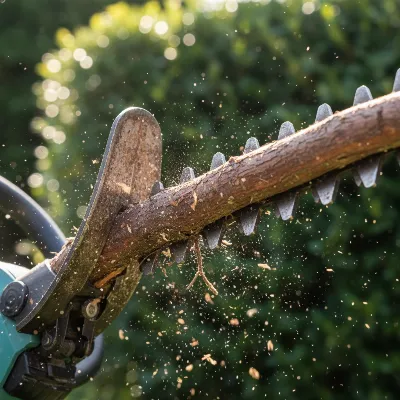 A hedge trimmer struggling to cut a thick branch, blades binding and motor straining.
Alternative Tools for Cutting Thick Branches Safely
When faced with branches too thick for a hedge trimmer, a range of specialized tools can get the job done efficiently and safely. Selecting the correct tool is crucial for both the health of your plants and your personal well-being.
- Pruning Shears (Hand Pruners): These are ideal for single, thin branches up to about 1 inch (28 mm) in diameter. They offer precise, clean cuts for delicate work and are perfect for shaping and removing deadwood on smaller plants.
- Loppers: With longer handles and more leverage than pruning shears, loppers are designed for branches that are too thick for hand pruners but still manageable, typically up to 1.5 to 2 inches (38-50 mm) in diameter.
- Pruning Saws: For larger, accessible branches that loppers can’t handle, a pruning saw is the go-to tool. These saws come with different blade types for green or dry wood and can cut branches up to 3.5 inches (90 mm) thick.
- Pole Saws: Essentially a mini chainsaw or saw blade attached to an extendable pole, pole saws are perfect for reaching high branches from the safety of the ground, eliminating the need for a ladder. They are excellent for trimming tree limbs that are manageable in thickness.
- Chainsaws: For very thick branches, large tree limbs, or felling small trees, a chainsaw is the most powerful option. However, chainsaws require significant training, protective gear, and extreme caution due to their inherent danger.
Here’s a comparison of these tools:
| Tool | Typical Branch Diameter Capacity | Best Use Cases | Key Advantages |
|---|---|---|---|
| Pruning Shears | Up to 1 inch (28 mm) | Small twigs, rose bushes, delicate pruning | Precision, easy to handle |
| Loppers | Up to 2 inches (50 mm) | Medium branches, dense shrubs, saplings | Leverage, reach |
| Pruning Saws | Up to 3.5 inches (90 mm) | Larger branches, small tree limbs | Efficient for thicker wood |
| Pole Saws | Varies by model (up to 6 inches) | High branches, inaccessible areas | Safe ground-level access, good reach |
| Chainsaws | Varies (several inches to feet) | Large branches, tree felling, heavy-duty cutting | High power, speed for very thick material |
Safe Hedge Trimming Practices (When Within Limits)
Even when using your hedge trimmer within its recommended limits, adhering to strict safety practices is paramount. These guidelines not only protect you but also ensure your trimmer operates effectively and maintains optimal condition.
Before you begin, always perform a pre-inspection of your equipment. Check that the blades are sharp, clean, and free of damage. Ensure all handles are securely attached and that any power cords are intact and not frayed. Dull blades can tear at foliage, leading to unhealthy cuts, and damaged cords pose an electrocution risk.
Personal Protective Equipment (PPE) is non-negotiable. Always wear:
- Safety glasses or goggles: To protect your eyes from flying debris.
- Heavy-duty gloves: To protect your hands from cuts and vibrations.
- Ear protection: Especially for petrol models, to guard against noise-induced hearing loss.
- Long sleeves and trousers: To protect your skin from scratches and cuts.
- Sturdy, closed-toe footwear: To provide grip and protection against falling branches or accidental contact.
Maintain a proper technique throughout the trimming process. Always hold the hedge trimmer firmly with both hands, maintaining a stable and balanced stance. Avoid overreaching, which can lead to a loss of balance and control. Work in a smooth, sweeping motion, letting the trimmer do the work rather than forcing it. If you encounter slight resistance, make multiple shallow passes rather than attempting to power through. Keep the power cord (if applicable) behind you and away from the blades to prevent accidental cutting. Ensure your work area is clear of obstacles, children, and pets.
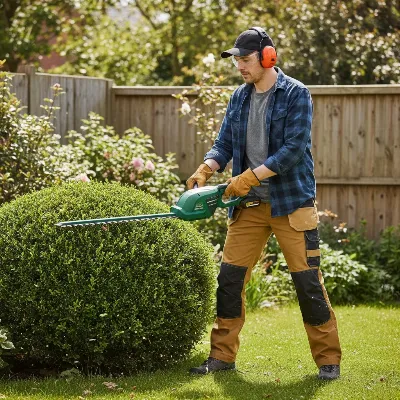 A person safely operating a hedge trimmer, wearing full protective gear in a well-maintained garden.
When to Call a Professional
While DIY gardening can be rewarding, there are specific situations involving thick branches or large-scale trimming where calling a professional arborist or tree service is not just recommended, but essential for safety and optimal plant health.
You should always consider professional help if:
- Branches are too thick for any of your home tools: If even your loppers or pruning saw struggle with the branch diameter, it’s time for an expert. Professionals have access to heavy-duty equipment like specialized saws and chainsaws, along with the training to operate them safely.
- Branches are high up or difficult to reach safely: Attempting to prune high branches from a ladder with power tools is extremely dangerous. Professionals use aerial lifts, climbing gear, and have the expertise to work at heights securely.
- The task involves large tree pruning or removal: Large trees require specific knowledge of tree biology and structural integrity to prune correctly without damaging the tree or creating hazards. Tree removal is a highly complex and dangerous job that should only be performed by certified professionals.
- Branches are near power lines or structures: Any work around electrical lines, buildings, or fences carries significant risks. Professionals are trained to navigate these sensitive areas safely and efficiently.
Conclusion
Hedge trimmers are invaluable tools for maintaining the aesthetic appeal and health of your garden’s hedges and shrubs, perfectly suited for light shaping and trimming of smaller, softer growth. However, it is crucial to recognize their inherent limitations; they are not designed for cutting thick branches safely or effectively. Attempting to force a hedge trimmer through material beyond its 3/4-inch to 1-inch capacity can lead to equipment damage, poor cuts that harm your plants, and, most importantly, a significant risk of personal injury through kickback or loss of control.
For any branches exceeding this thickness, a range of specialized tools, including pruning shears, loppers, pruning saws, and pole saws, provide safer and more efficient solutions. Prioritizing safety through proper tool selection, wearing appropriate personal protective equipment, and employing correct trimming techniques ensures a rewarding and risk-free gardening experience. Remember, when in doubt, especially with large or hard-to-reach branches, consulting a professional arborist is always the wisest choice for both your safety and the vitality of your landscape.
Frequently Asked Questions
Can a battery hedge trimmer cut thick branches?
Battery hedge trimmers, like corded or petrol models, are limited by their blade gap and motor strength, typically handling branches up to 3/4 to 1 inch (19-25 mm). Forcing them through thicker material can strain the motor and damage the blades, similar to other types of trimmers.
What is the thickest branch a hedge trimmer can cut?
Most hedge trimmers are designed to cut branches up to 3/4 inch (19 mm) in diameter. Some heavy-duty models might manage up to 1 inch (25 mm). Anything thicker generally requires an alternative tool like loppers or a pruning saw for a clean cut and to prevent tool or plant damage.
What happens if I cut thick branches with a hedge trimmer?
Cutting thick branches with a hedge trimmer can lead to motor strain or burnout, bent or broken blades, and ragged cuts that are unhealthy for the plant. Critically, it increases the risk of kickback, causing loss of tool control and potential serious injury.
Can I use a hedge trimmer for small tree branches?
Hedge trimmers are generally not suitable for tree branches, even small ones, if they exceed the trimmer's maximum diameter capacity of about 1 inch (25 mm). Tree branches are often denser and tougher than hedge foliage. For small tree branches, pruning shears or loppers are better suited for cleaner cuts.
What's the best tool for trimming overgrown hedges with thick stems?
For overgrown hedges with thick stems exceeding a hedge trimmer's capacity, a combination of tools is often most effective. First, remove the thickest stems using loppers or a pruning saw. Once the bulk is cleared, a hedge trimmer can then be used to shape and finish the hedge for a neat and healthy appearance.

I’ve always wondered about pushing my hedge trimmer to its limits, especially with some of the older, thicker growth in my backyard. This really clarified that trying to cut anything over 3/4 inch is just asking for trouble. I used to get frustrated when it wouldn’t power through, but now I understand it’s not designed for that kind of brute force. Definitely sticking to my loppers for the bigger stuff from now on.
My hedge trimmer is great for general maintenance and keeping things tidy, but I did try to tackle a few slightly thicker branches last season and it was a mess. The cuts were really ragged, and I felt like I was forcing it. It’s good to know that the rapidly oscillating blades are really meant for softer, thinner stems. I wish they made a model that could handle just a little bit more without having to switch tools.
This was super helpful! I’ve been using my hedge trimmer for years, mostly for light shaping, but I always had a nagging doubt about what its actual capacity was. The mention of kickback and loss of control when trying to cut thicker material really hit home. It’s a good reminder to respect the tool’s limitations and prioritize safety over trying to get everything done with one piece of equipment.
Spot on advice! I’ve seen too many people try to force their hedge trimmers through branches that are clearly too big, and it’s just a recipe for damaging the tool or worse, hurting themselves. Understanding that these tools are engineered for speed and uniform cuts on thinner material, not brute force, is key. It’s why I always keep a good pair of bypass pruners handy for anything over half an inch.